Thursday, September 29, 2016

Will driverless cars be common by 2035?


Remember as a kid watching old Sci-fi movies where there were cars that drove themselves and drivers could coast with auto-pilot? It all seemed far off, as if pertaining to a futuristic society. Well, some of those "futuristic" ideas may actually be on the verge of becoming a reality - and they might be doing so a lot sooner than you think!

Today, automakers around the globe are currently working on various different technologies that not only include cars without drivers, but they're taking it one step further by putting these vehicles on the road.
For example, Audi recently obtained a permit from the state of California to test drive vehicles on public streets. Other auto makers aren't far behind as Volvo and Mercedes Benz are in the process of testing out different vehicles.


You may be surprised to learn that some non-auto manufacturers are also racking up miles with driverless cars as well. Google, for instance, currently has about 700,000 test miles on its own version of cars without drivers. IBM, Intel, and Cisco Systems are also in the game. With so many driverless explorations happening, it seems as though the future is now.

So what are the implications of all this? In terms of investment, it could be substantial. According to Morgan Stanley, the benefit of autonomous cars alone for the United States economy could be somewhere in the range of between $700 billion to $2.2 trillion per year. In any case, driverless vehicles are certain to transform the auto industry - and our lives - in many ways, likely by the end of this decade.

Source: Chris Bryant and Andy Charman, “Race Is on to Build World’s First Driverless Car,” October 13, 2014.


"Some Google employees have their self driving vehicles take them to work. These cars are a bunch of sensors, wires, and software. This technology 'works'." - Tyler Cowen

Energy Independence: The Dream is Becoming a Reality.

Energy Independence: The Dream is Becoming a Reality.

For many years, the argument has raged on regarding how the United States should go about obtaining and paying for its oil reserves. This debate has been the subject of many heated discussions - and it may be for many years to come. However, the concept of U.S. energy independence is becoming a reality much sooner than many people realize, halting the argument in its tracks.

Back in early 2007, many Americans believed that the future of the United States energy industry appeared to be bleak. Since then, however, a major transformation has taken place - primarily in the country's three largest oil fields - in terms of key oil production figures.

The Bakken, the Eagle Ford, and the Permian Basin, have all increased their oil production from 1 million barrels per day to an estimated 4.6 million barrels per day (as of year-end 2014). In fact, the oil production in Texas alone was more than 3.1 million barrels per day, the most in more than 33 years, according to the Energy Information Administration.

Given this steep increase in U.S. oil production of late, a longer-term trend towards energy independence could actually become a reality, lessening our future dependency on foreign oil producers.


There are still some questions with regard to long-term sustainability of U.S. oil production going into the future. However, it could be a positive opportunity and dream come true not just for U. S. oil producers, but also for consumers and investors alike.

Source: U.S. Energy Information Administration. Data represent thousands of barrels per day (bpd) for the month of July 2014.


"As long as the United States - and the world - gets its oil from the Middle East, we will be drawn into the endless crises that seem endemic to the region. American energy independence would not only liberate us, it would also drive down the worldwide price of oil." - Kathleen Trola McFarland

Income is growing faster than any time in history.


In many parts of the world today, money is continuing to set new speed records. No, these records can’t be measured in miles per hour, but rather in terms of Gross Domestic Product (GDP) in various areas of the globe. And, as time marches forward, the speed with which money is moving continues to increase.

As an example, in the past, it took approximately 150 years from the beginning of Britain's industrial revolution for Gross Domestic Product per person (measured as purchasing power) to double. Roughly 120 years later, in America, this was accomplished in roughly one-third the time. But even more recently, though, in China, it has doubled in only 12 years and with 100 times fewer people.


In addition to the rise in GDP, the average incomes in developing countries are also growing faster than they ever have in the past. While China and Asia are responsible for a great deal of this new wealth, South Korea, Mexico, and Nigeria are also following suit.

Around the world, there are millions of people who are moving quickly into the "middle class." This means more discretionary income is available and ready to be spent on goods and services. This speedy transition has, in turn, provided a golden opportunity for businesses - and investors - as consumers continue to spend.


"By increasing productivity and becoming more competitive, we will be able to offer better opportunities and improve the standard of living for all Mexicans." - Enrique Pena Nieto


Source: Urban World:Cities and the Rise of the Consuming Class, June 2012, McKinsey Global Institute

The digital revolution is lifting the world to a new level.

The digital revolution is lifting the world to a new level.

While many people understand that the Internet and smartphones are changing the way that we live and work today, what most may not realize is that this modern "digital revolution" of today actually got its start more than two and a half centuries ago.

What we now refer to as the Digital Revolution - inclusive of laptop computers, cell phones, tablets, e-readers, and other modern electronics - was actually begun 250 years ago. The first and second Industrial Revolutions preceded the Digital Revolution, opening a pathway for the evolution of technology and modernization. Over time, our global economy has shifted from relying on people for operations to relying on technology for efficiency.

When you think about it, though, it all makes a lot of sense. This is because as our needs change, new devices are constantly being developed in order to replace the old ones. For example, the water mill was replaced by the steam engine, the computer replaced the transistor, etc. In fact, each new wave of technology brings about new surges in productivity - and because of that, new businesses are able to consistently emerge.


Many of these technologies have led to substantial advances that have improved the overall standard of living across the globe. And, some of our biggest businesses today are providing opportunity for both commerce - and investment - that people did not even imagine just a decade ago. Some examples include the Apple iPhone, tablets, and the Go-Pro. With easy access to endless technology, we could be in the midst of the next level of the digital revolution.

"The number one benefit of information technology is that it empowers people to do what they want to do. It lets people be creative. It lets people be productive. It lets people learn things they didn't think they could learn before, and so in a sense it is all about potential."

- Steve Ballmer

The Future Looks Bright.


Today, we are living through an era that is just as significant as the Industrial Revolution was so many years ago. In these modern times, change is being created almost at the speed of light - and, with these changes, there are both big challenges and opportunities that are presenting themselves for long-term investors.

While some of these changes may be slow to develop, they are having profound implications for the entire world economy. One example is the evolution of a middle class in developing countries. Many of these individuals have gone from lacking opportunity to creating opportunity, by establishing their own businesses and moving forward financially. Literally hundreds of millions of people are being affected - and it is likely that the effect will continue to build. 

Other changes have burst onto the scene quite rapidly, such as smart phones and the Internet. Today, people from all corners of the globe have more access to information than ever before - and that is powerful. This is something that was unimaginable even just a decade ago, but today is common.

While we may not see inventions like hover boards or flying cars any time in the near future, the inventions that we do have such as the Internet and instant communication have created significant opportunities - for people and for investment - worldwide, for both the short- and the long-term horizon.


"Knowledge is power. Information is liberating. Education is the premise of progress, in every society, in every family" - Kofi Annan

Thursday, July 21, 2016

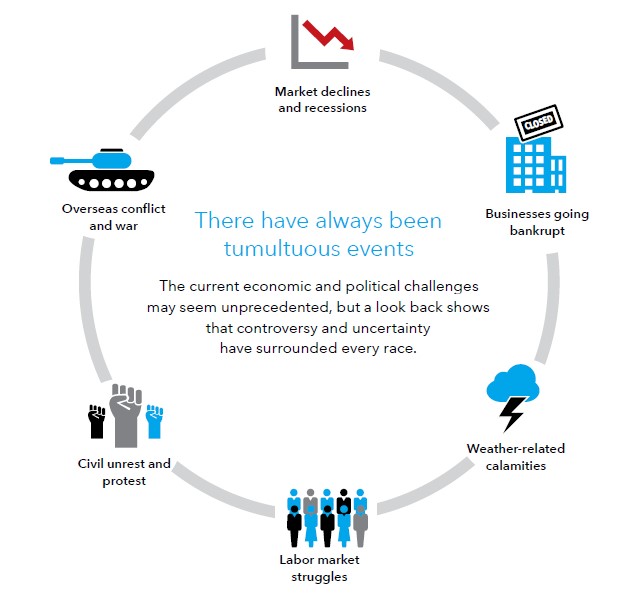
There have always been tumultuous events. How you react to them is what really matters.


For most people, action is the antidote to anxiety. However, taking action is usually the wrong thing to do when you're a long-term investor. And, investor doubts are especially prevalent during presidential election years.
To help you stick to your long-term investment goals, even during the current political scene, consider the following:


→ Successful long-term investors stay the course and rely on time rather than timing. 


→ Investment success depends more on the strength and resilience of the American economy than on which candidate or party holds office. 


→ Working closely with experienced investment professionals who have you best interest in mind is the first step to helping reach your long-term goals. 


→ Long-term investing should be based on your lifetime and not what's happening in the news.


Don't forget that it is inherently in the media's best interest to fixate on the negative because it sells more advertisements. 


"Headlines, in a way, are what mislead you because bad news is a headline, and gradual improvement is not."

Bill Gates

Friday, May 27, 2016

The Critical Factor is not Red or Blue, but You.

As the battle for the White House heats up, candidates are drawing attention to the challenges facing the nation--everything from economic instability to immigration. With all this negative campaign rhetoric, it's no wonder investors grow more concerned. However, history shows the value of not giving in to election-year fears.

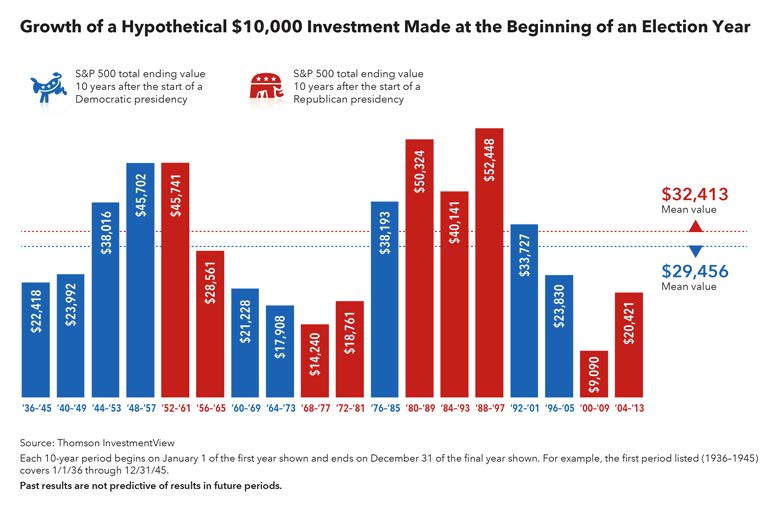
In fact, investing during election years has almost always turned out to be a good idea for long-term investors as you can see in this chart. When preparing to invest, however, the most important decision that needs to be made is deciding to commit to the long-term big picture. This commitment is what helps you ride the natural ebb and flow of the market.

As you can also see from this chart, it doesn't really matter whether Republicans or Democrats are in office. Investment success really depends more on the strength of the U.S. economy, which, according to Mike Kerr, portfolio manager at Capital Group, there are many reasons for optimism about the future of the U.S. Please watch U.S. Outlook Bright-and Only Getting Brighter if you would like to hear more from Mike Kerr.


"The Tortoise, in the meantime, continued to plod on, albeit, ever so slowly. He never stopped, but took one good step after another."  "The Hare dashed as quickly as anyone ever could up to the finish line, where he met the Tortoise, who was patiently awaiting his arrival."

The Tortoise and the Hare
an Aesop Fable