Thursday, September 29, 2016

The digital revolution is lifting the world to a new level.

The digital revolution is lifting the world to a new level.

While many people understand that the Internet and smartphones are changing the way that we live and work today, what most may not realize is that this modern "digital revolution" of today actually got its start more than two and a half centuries ago.

What we now refer to as the Digital Revolution - inclusive of laptop computers, cell phones, tablets, e-readers, and other modern electronics - was actually begun 250 years ago. The first and second Industrial Revolutions preceded the Digital Revolution, opening a pathway for the evolution of technology and modernization. Over time, our global economy has shifted from relying on people for operations to relying on technology for efficiency.

When you think about it, though, it all makes a lot of sense. This is because as our needs change, new devices are constantly being developed in order to replace the old ones. For example, the water mill was replaced by the steam engine, the computer replaced the transistor, etc. In fact, each new wave of technology brings about new surges in productivity - and because of that, new businesses are able to consistently emerge.


Many of these technologies have led to substantial advances that have improved the overall standard of living across the globe. And, some of our biggest businesses today are providing opportunity for both commerce - and investment - that people did not even imagine just a decade ago. Some examples include the Apple iPhone, tablets, and the Go-Pro. With easy access to endless technology, we could be in the midst of the next level of the digital revolution.

"The number one benefit of information technology is that it empowers people to do what they want to do. It lets people be creative. It lets people be productive. It lets people learn things they didn't think they could learn before, and so in a sense it is all about potential."

- Steve Ballmer

The Future Looks Bright.


Today, we are living through an era that is just as significant as the Industrial Revolution was so many years ago. In these modern times, change is being created almost at the speed of light - and, with these changes, there are both big challenges and opportunities that are presenting themselves for long-term investors.

While some of these changes may be slow to develop, they are having profound implications for the entire world economy. One example is the evolution of a middle class in developing countries. Many of these individuals have gone from lacking opportunity to creating opportunity, by establishing their own businesses and moving forward financially. Literally hundreds of millions of people are being affected - and it is likely that the effect will continue to build. 

Other changes have burst onto the scene quite rapidly, such as smart phones and the Internet. Today, people from all corners of the globe have more access to information than ever before - and that is powerful. This is something that was unimaginable even just a decade ago, but today is common.

While we may not see inventions like hover boards or flying cars any time in the near future, the inventions that we do have such as the Internet and instant communication have created significant opportunities - for people and for investment - worldwide, for both the short- and the long-term horizon.


"Knowledge is power. Information is liberating. Education is the premise of progress, in every society, in every family" - Kofi Annan

Thursday, July 21, 2016

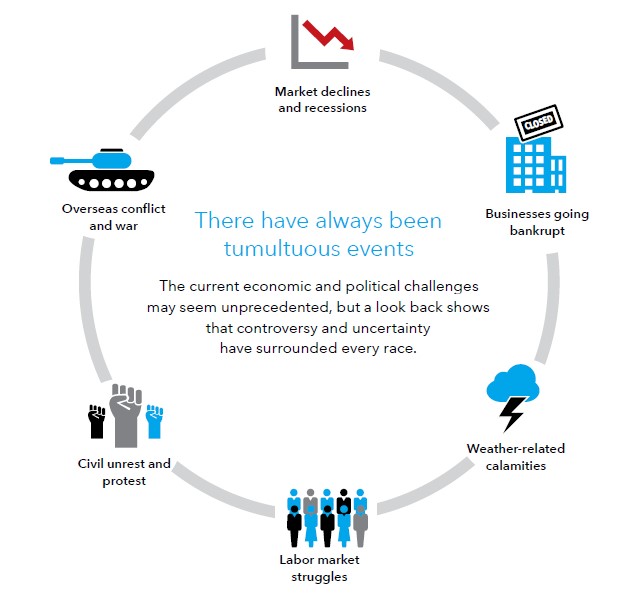
There have always been tumultuous events. How you react to them is what really matters.


For most people, action is the antidote to anxiety. However, taking action is usually the wrong thing to do when you're a long-term investor. And, investor doubts are especially prevalent during presidential election years.
To help you stick to your long-term investment goals, even during the current political scene, consider the following:


→ Successful long-term investors stay the course and rely on time rather than timing. 


→ Investment success depends more on the strength and resilience of the American economy than on which candidate or party holds office. 


→ Working closely with experienced investment professionals who have you best interest in mind is the first step to helping reach your long-term goals. 


→ Long-term investing should be based on your lifetime and not what's happening in the news.


Don't forget that it is inherently in the media's best interest to fixate on the negative because it sells more advertisements. 


"Headlines, in a way, are what mislead you because bad news is a headline, and gradual improvement is not."

Bill Gates

Friday, May 27, 2016

The Critical Factor is not Red or Blue, but You.

As the battle for the White House heats up, candidates are drawing attention to the challenges facing the nation--everything from economic instability to immigration. With all this negative campaign rhetoric, it's no wonder investors grow more concerned. However, history shows the value of not giving in to election-year fears.

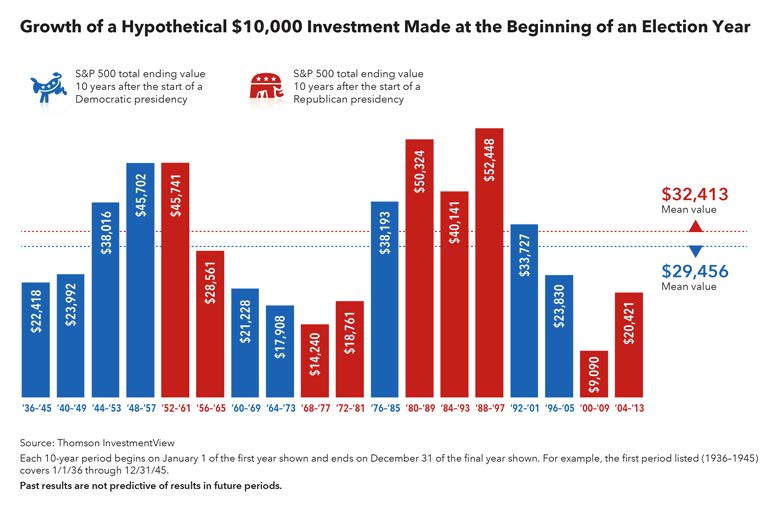
In fact, investing during election years has almost always turned out to be a good idea for long-term investors as you can see in this chart. When preparing to invest, however, the most important decision that needs to be made is deciding to commit to the long-term big picture. This commitment is what helps you ride the natural ebb and flow of the market.

As you can also see from this chart, it doesn't really matter whether Republicans or Democrats are in office. Investment success really depends more on the strength of the U.S. economy, which, according to Mike Kerr, portfolio manager at Capital Group, there are many reasons for optimism about the future of the U.S. Please watch U.S. Outlook Bright-and Only Getting Brighter if you would like to hear more from Mike Kerr.


"The Tortoise, in the meantime, continued to plod on, albeit, ever so slowly. He never stopped, but took one good step after another."  "The Hare dashed as quickly as anyone ever could up to the finish line, where he met the Tortoise, who was patiently awaiting his arrival."

The Tortoise and the Hare
an Aesop Fable

Thursday, January 14, 2016

Losing money in the market feels twice as bad as making money in the market.

Psychology tells us that we feel losses in our investments twice as strongly as we feel gains. It is called loss aversion. So why invest at all? Some people just enjoy the sport of investing, but most families invest in order to meet their long-term goals. That’s easier said than done when your investments are losing money. Sometimes when we get caught up in our concerns about short-term market losses, it becomes hard to stay focused on our long-term goals. Thank you Mr. Brain and loss aversion! Add the 24/7 news cycle on top of that and it gets even trickier.

Since losing money feels twice as bad, why not skip taking the risk of losing money in our investments altogether? The problem is that you have to take risk to get returns that are better than a savings account interest rate.

Most families need higher returns over the long run, so severe risk aversion may not be the best option. If you’re taking risk, then you’re either going to see your accounts go up or go down.  Quite frankly, it’s also possible to pay an insurance company to take on the risk for you, usually for a handsome fee.
 
The reward of interest in your savings account is small because your risk is small. It takes risk to have the opportunity to increase your returns and that means you will probably watch your accounts go up and down in the short run.

"Most people would rather be certain they're miserable, than risk being happy." - Robert Anthony


Friday, November 6, 2015

Are you affected by the Bipartisan Act of 2015?

President Obama recently signed the Bipartisan Budget Act of 2015 into law. This two-year budget deal is designed to close perceived loopholes in social security claiming strategies. It eliminates the ability to file for dependent spousal benefits on a retiree’s record when that retiree is not currently receiving benefits. The dependent spouse will now be limited to receiving the higher of his or her own or spousal benefit.

The good news is that those who have already filed for and immediately suspended benefits, while their spouse is receiving spousal benefits through a restricted application—can continue doing so!

But new social security claimants will definitely see a change in their options.

 1. If you and your spouse are less than six months away from reaching your full retirement age (FRA) for social security, there is still a window of opportunity for you to file for dependent spousal benefits.
 2. If you turn age 62 by year-end 2015, you may still be able to file a restricted application for spousal dependent benefits when you reach your FRA.


We continue to monitor these rule changes closely and are ready to discuss your social security planning strategy with you in light of this new legislation. If you have any questions or concerns about your family’s social security claiming plan, please feel free to call our office at 281.990.7100.

Tuesday, August 25, 2015

Nurturing an Independent College Student


In a recent appointment, I was talking with clients who are sending their daughter off to college for the first time. I was reminded that August is when many are going through this exciting, and sometimes scary transition. The majority of what my clients wanted to talk about wasn’t so much about how their portfolio was doing, but how they can help their daughter manage her own finances for the first time. As a parent having gone through this, I get it!

Here are a few things that came to mind which may help you or someone you know:
Decide who’s paying for what up front. Discuss with your student what you plan to cover (tuition, housing, meal, plans, and so on) and what expenses you expect your child to pay for. 

Make a budget. Work with your student to figure out how much money they’ll need per month, whether using their savings or from an allowance you’re providing. 

Don’t save them. It’s pretty easy to fall prey to sympathy for your student who is dealing with so much newness, but try not to just give in to the requests for more money. 

After they prove themselves. Although you shouldn’t save them when they’re struggling to stay inside a budget, there’s nothing wrong with rewarding success at handling their finances. Perhaps a nice dinner at their favorite restaurant or a little extra cash left behind on a visit.

Provide motivation to do well. If you are paying for your student to go to college, consider telling them you’ll pay for the spring semester in percentages based on how well they do in the fall.

It’s true that your child will face many challenges when leaving home for the first time. But, it’s much better for everyone if you are a little tough in the beginning. You would be amazed at how often the subject of dependent adult children comes up during client meetings! The universal plan is for our children to eventually learn to be financially independent adults, is it not?
www.selahfs.com